Introduction: The Standardized Diagnosis of Androgenetic Alopecia
Androgenetic Alopecia (AGA), commonly known as Male Pattern Baldness (MPB), is the predominant form of progressive hair loss in men. Accurate diagnosis and timely intervention are crucial for effective management.
To standardize the classification of this condition globally and guide treatment protocols, the medical community relies on the Norwood–Hamilton Classification System, often referred to simply as the Norwood Scale.
This article details the 7 clinically recognized stages of MPB, empowering you to understand your current stage and the most effective, evidence-based treatment path available.
For a comprehensive medical overview of this condition, including causes, symptoms, and diagnosis, consult this resource from Cleveland Clinic.
Table of Contents
What Is the Norwood–Hamilton Classification System?
The Norwood Scale (formally the Norwood–Hamilton Classification System) is the internationally recognized, clinical standard used to categorize the extent and pattern of male androgenetic alopecia (Male Pattern Baldness).
- Origin: Developed by Dr. James Hamilton in the 1950s and later refined and popularized by Dr. O’Tar Norwood in the 1970s.
Purpose and Application
The system provides a clear, systematic, sequential framework—detailing how baldness develops from a normal hairline (Stage 1) to advanced baldness (Stage 7)—to help clinicians:
- Establish a precise baseline diagnosis for hair loss.
- Monitor the rate of hair loss progression over time.
- Design an evidence-based, stage-appropriate treatment plan.
- Guide all modern hair loss research, clinical trials, and surgical planning.
Dermatologists and hair specialists rely on the Norwood Scale to ensure consistency in diagnosis and to select the most effective treatment, as solutions vary significantly by stage (e.g., Minoxidil for early stages vs. hair transplant for advanced stages).
A detailed study on classifying male-pattern hair loss can help you understand different stages and patterns.
- Note: While this system is invaluable for self-assessment, a board-certified dermatologist or hair specialist is required for a definitive stage classification and personalized treatment plan.
The 7 Stages of Male Pattern Baldness (Norwood Scale)
The Norwood Scale systematically progresses through seven distinct stages, providing a clear clinical roadmap of Male Pattern Baldness (MPB) evolution.
Note on Diagnosis: While these descriptions offer a useful guide, definitive stage classification and personalized treatment planning require consultation with a board-certified dermatologist or hair restoration specialist.
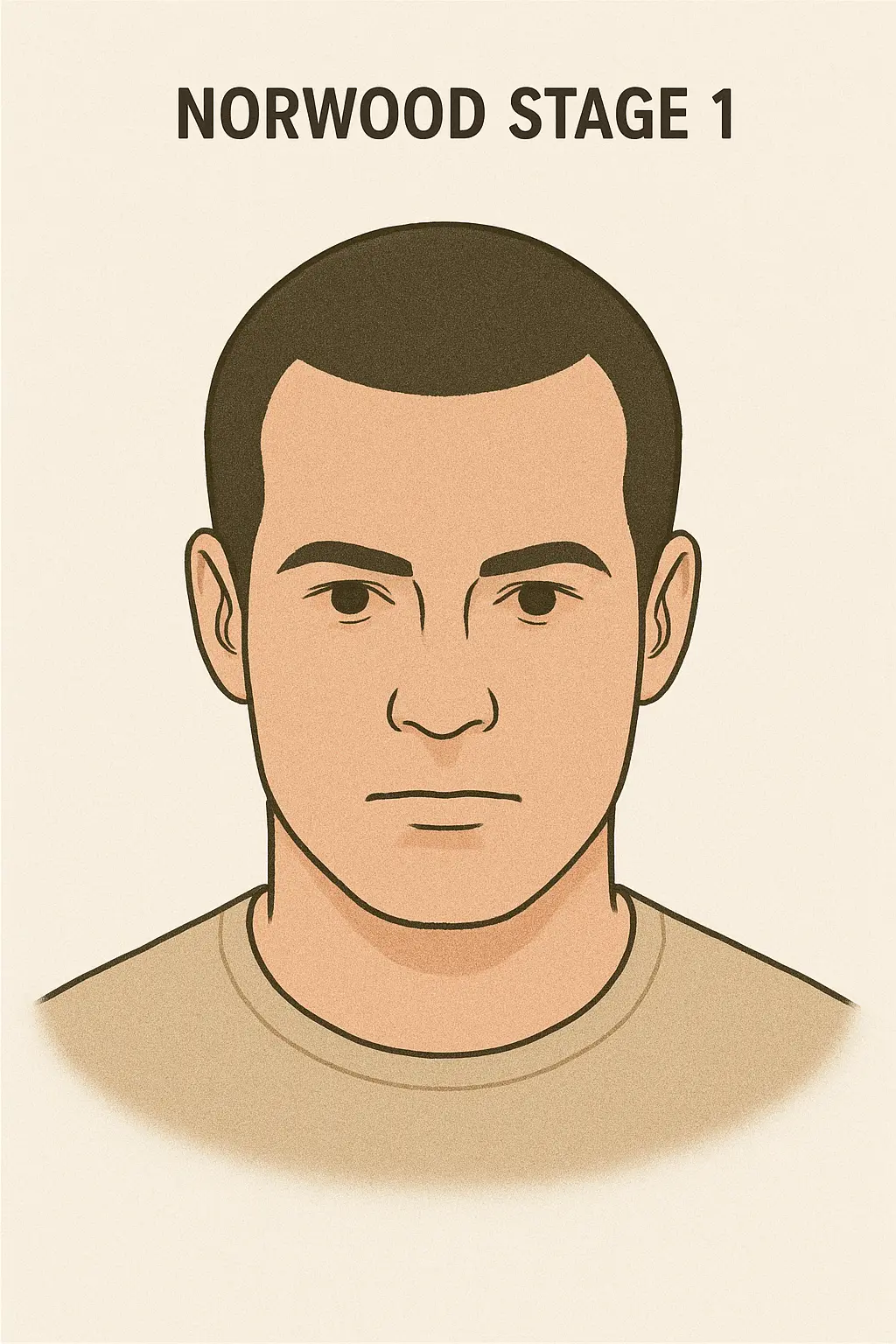
Stage 1 – Control / Pre-Loss
- Clinical Observation: This is the non-balding stage. The hairline is full and non-receded, with no visible thinning in the temporal (temples) or vertex (crown) areas.
- Intervention Focus: No medical treatment is indicated. Focus is on preventative health: maintaining essential nutrient intake, managing stress, and monitoring hair density.
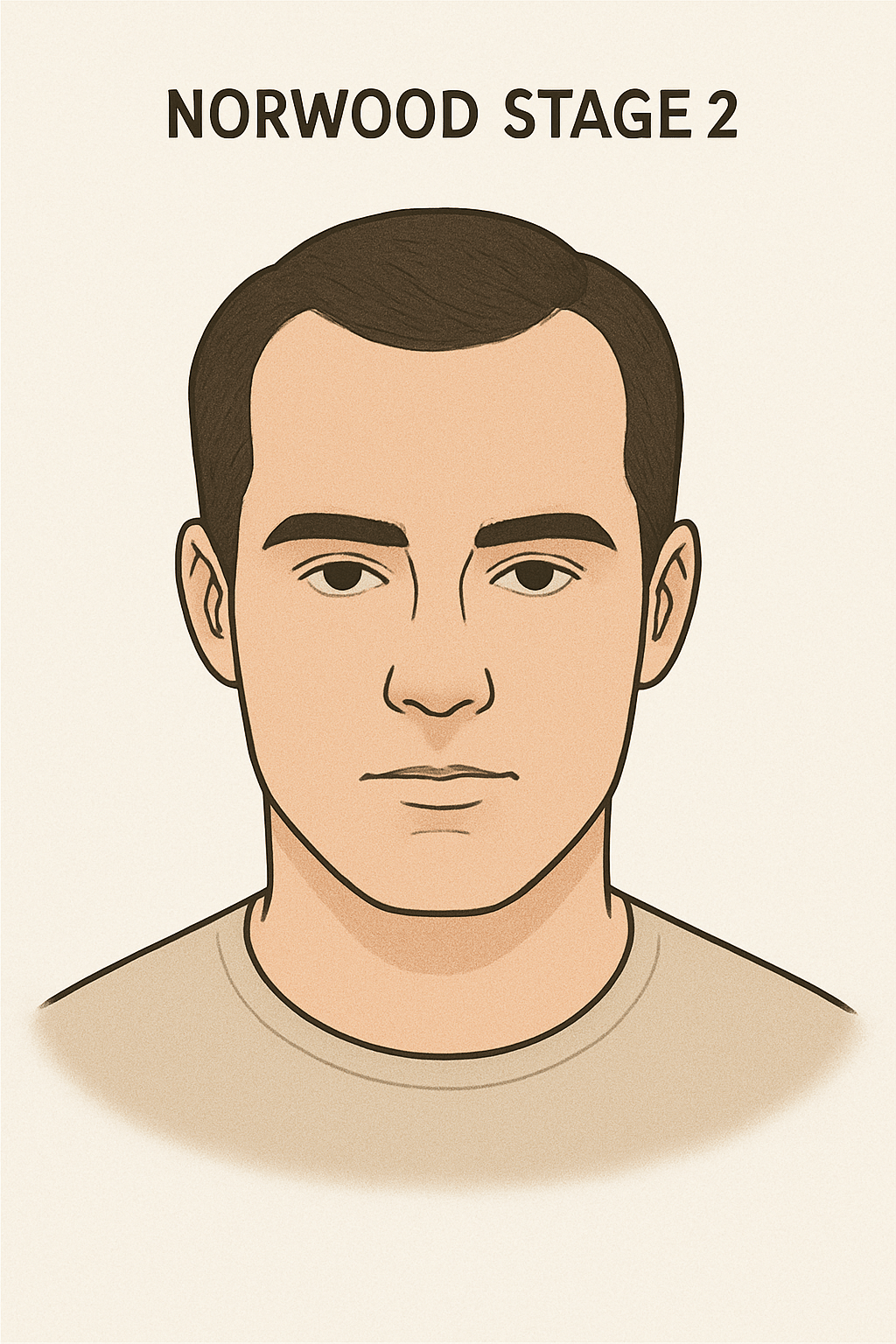
Stage 2 – Slight Recession
- Clinical Observation: Initial, minor recession becomes visible at the temporal regions (front corners). The hairline remains largely anterior (in front of) the ears’ external meatus. This stage is sometimes referred to as the ‘adult‘ or ‘mature‘ hairline.
- Intervention Focus: Early intervention can be beneficial. Consider topical Minoxidil 5% to support scalp health and microcirculation, though prescription medication is not typically required.
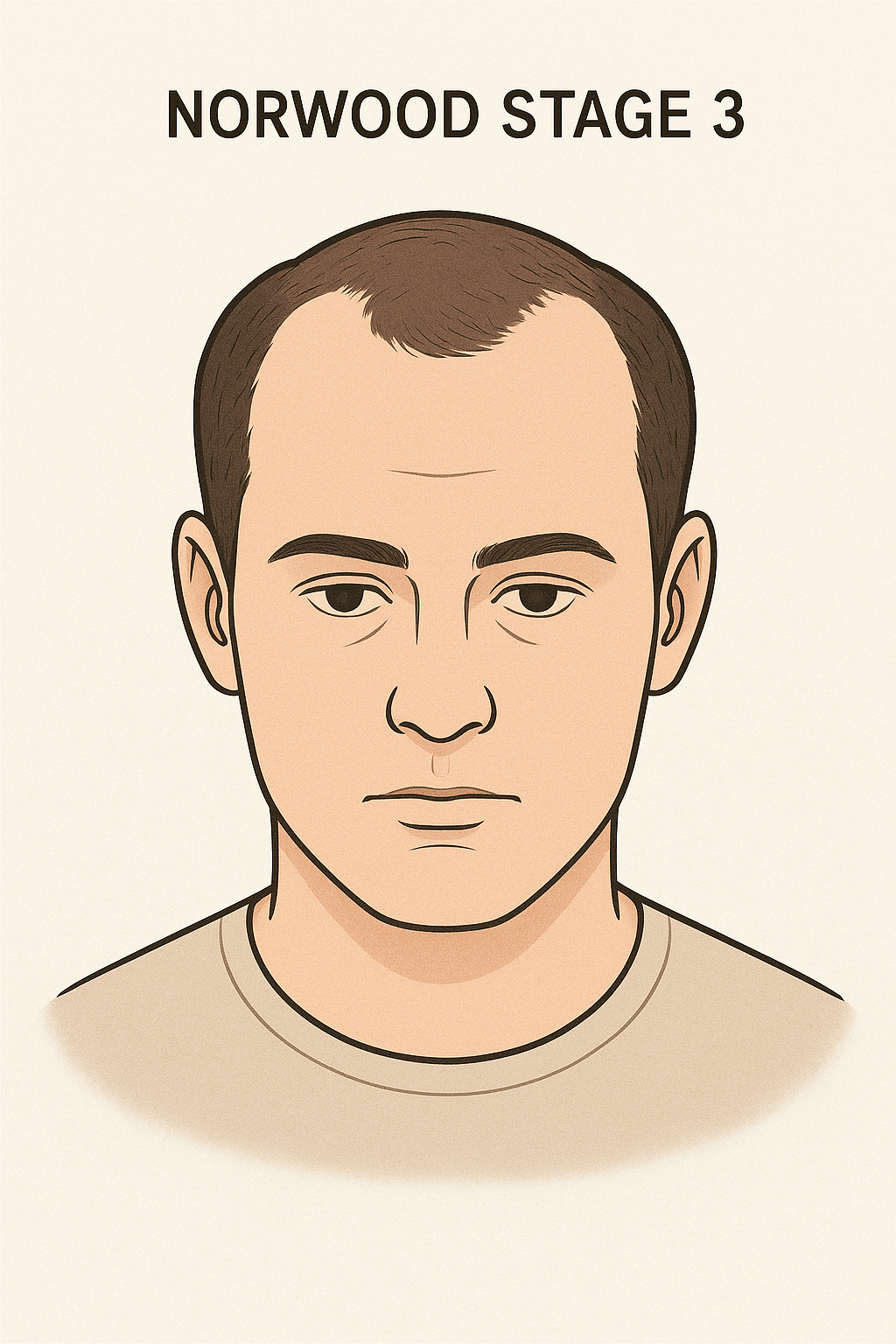
Stage 3 – Clinically Significant Balding
- Clinical Observation: Hair loss is clear and distinct. There is defined recession at the temples, often creating a pronounced ‘M,’ ‘U,’ or ‘V’ pattern. This is considered the first clinically significant stage requiring medical therapy assessment.
- Intervention Focus: High efficacy for FDA-approved prescription treatments, namely Oral Finasteride (to inhibit DHT) and/or Topical Minoxidil. Consultation is mandatory to initiate therapy.
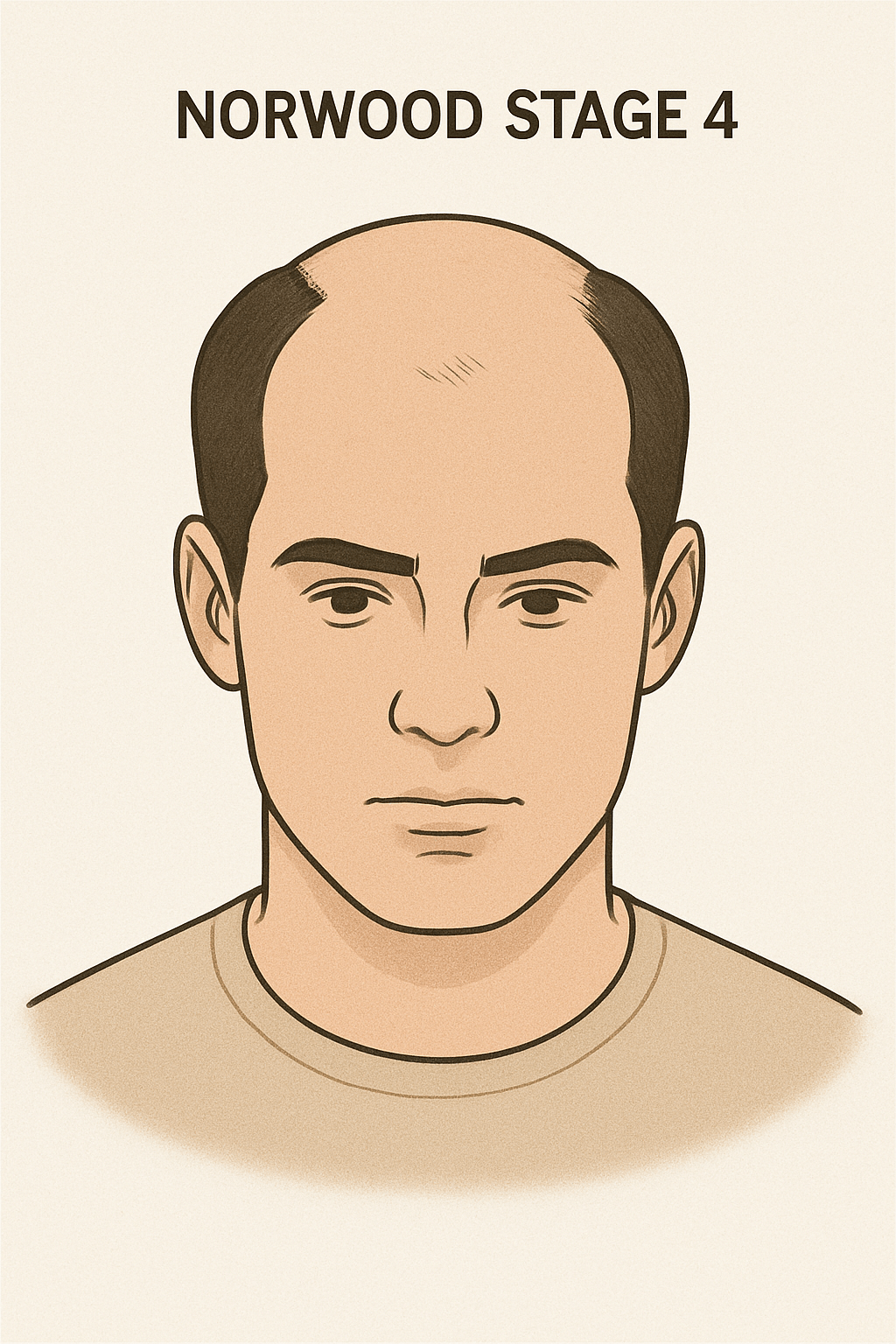
Stage 4 – Deepening Recession & Early Crown Loss
- Clinical Observation: The frontal recession is more severe than Stage 3. Crucially, a distinct, separate bald patch appears or is visibly thinning at the vertex (crown). A solid, albeit thinning, bridge of hair still separates the frontal and crown loss areas.
- Intervention Focus: Aggressive combination therapy (Finasteride and Minoxidil) is recommended. Early assessment for hair transplant surgery (FUE/FUT) may be warranted, particularly if non-response to medication is noted.
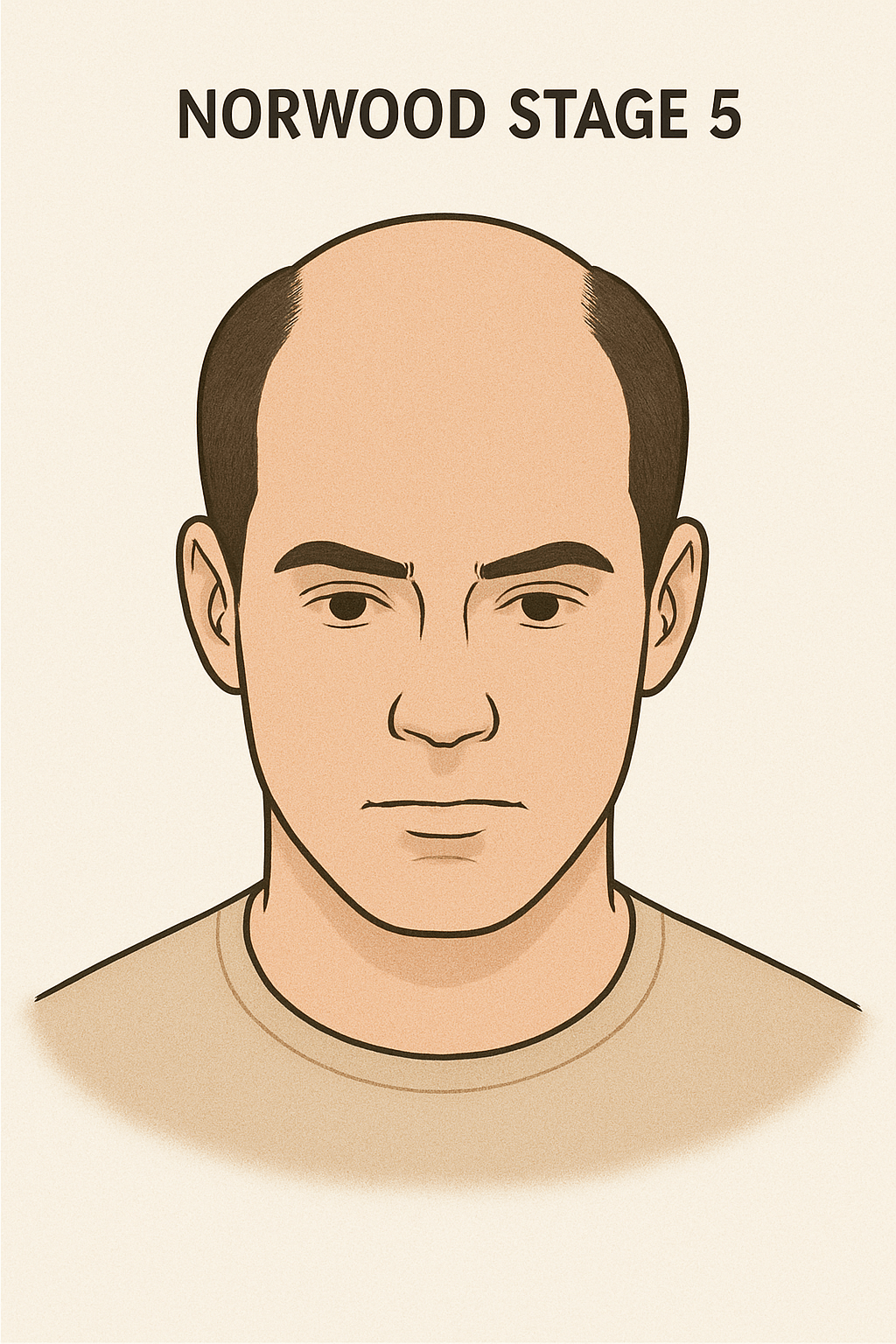
Stage 5 – Extensive Balding
- Clinical Observation: The bald areas at the temples and crown grow larger and the bridge of hair separating them narrows significantly and becomes sparse. Hair loss is now extensive and visually apparent from multiple angles.
- Intervention Focus: This is often an optimal stage for surgical intervention (Hair Transplant) to restore coverage, combined with continuous medical management to preserve all remaining hair.
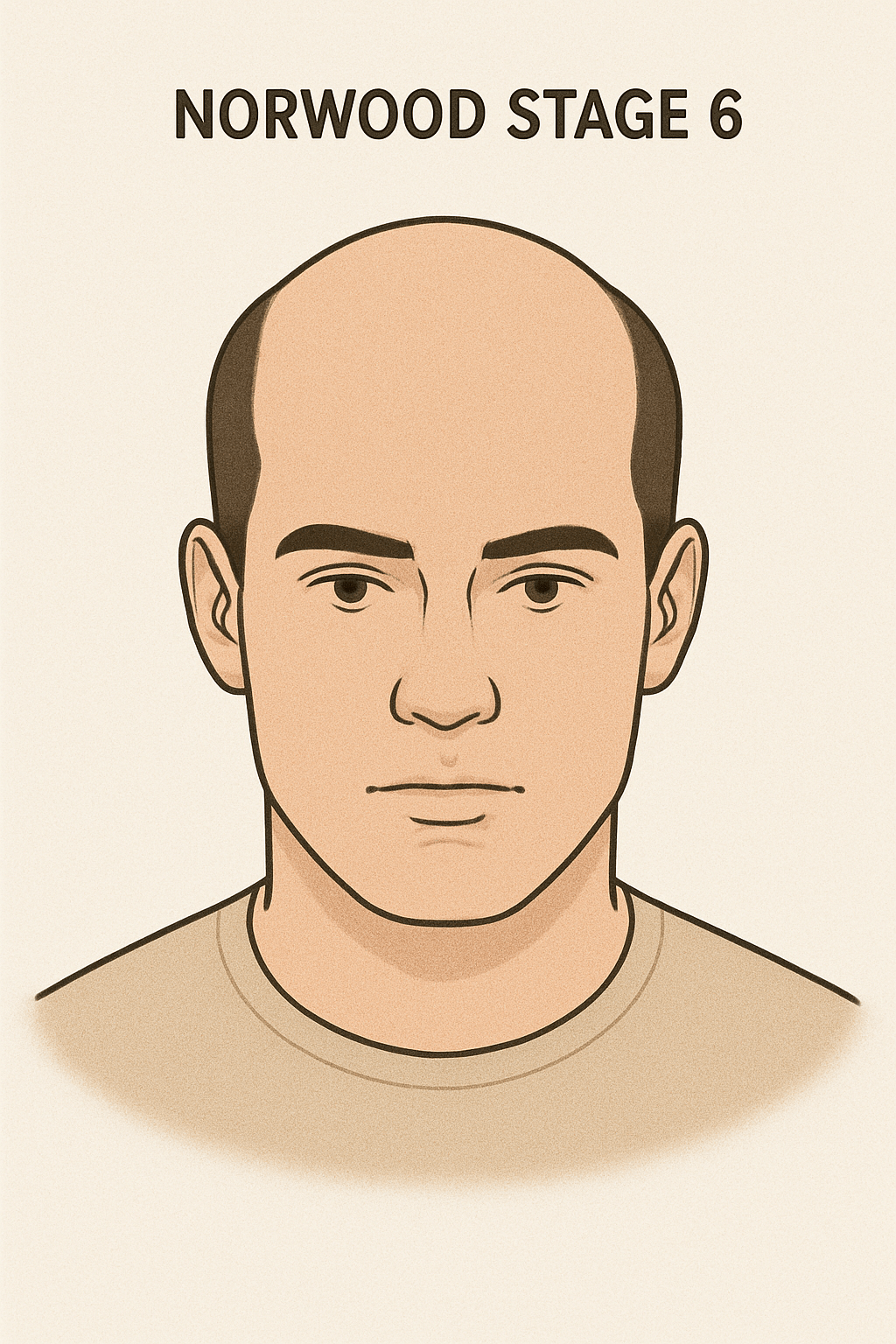
Stage 6 – Severe Hair Loss
- Clinical Observation: The bridge of hair across the top of the scalp is lost or severely miniaturized. The frontal and crown bald areas merge into a single, large zone of baldness. Only a thin, sparse lateral and posterior band of hair remains.
- Intervention Focus: Surgical restoration remains the most effective option, provided donor hair density is sufficient. Non-surgical alternatives like Scalp Micropigmentation (SMP) are strong options.
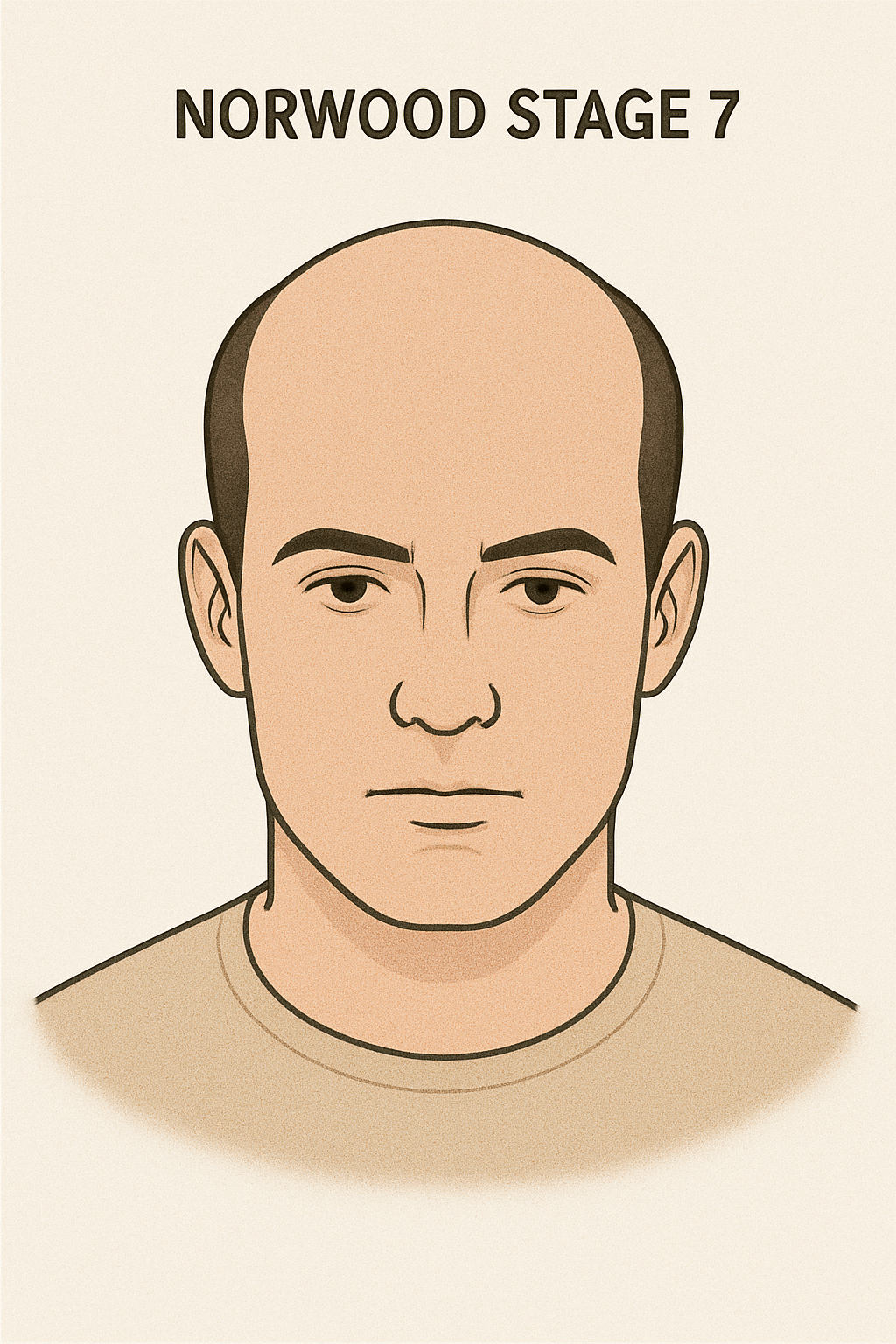
Stage 7 – Maximal Hair Loss
- Clinical Observation: This is the most severe stage. Only a thin, sparse ‘horseshoe’ band of hair remains around the sides and back of the scalp (occipital and lateral zones). The entire superior scalp is bald.
- Intervention Focus: Transplant effectiveness is severely limited by critical donor hair deficiency. Practical, non-surgical solutions include SMP or advanced hair systems.
Why Knowing Your Stage Matters
Identifying your stage of male pattern baldness (MPB) is not just about looks—it directly affects your treatment and results. Here’s why knowing your exact classification on the Norwood Scale is important:
- Helps pick the right treatment: Each stage has different solutions. For example, Norwood Stage 2 may only need lifestyle changes and Minoxidil, while Norwood Stage 5 might require a hair transplant. Knowing your stage helps you avoid wasting money or time on the wrong approach.
- Sets realistic expectations: If you are in the early stage, you may see strong regrowth with treatment. But in advanced stages, the focus is more on slowing hair loss or restoring appearance with transplants or SMP. Understanding your Norwood stage keeps your expectations practical.
- Guides doctor prescription: Dermatologists and hair specialists use the Norwood Scale as the primary reference when recommending medicines like Finasteride or Minoxidil, or when suggesting surgical options.
Treatment Pathways Correlated with Norwood Scale Stage
Choosing the correct treatment must be guided by your stage on the Norwood Scale for optimal results and realistic expectations.
Stages 1–3 (Prevention and Pharmacological Response)
The focus here is on halting progression and, potentially, regrowing miniaturized hair. This is the optimal window for medical therapy, where the Norwood Scale indicates high potential for stabilization.
Primary Treatment: FDA-approved pharmacotherapy.
- Oral Finasteride (reduces DHT and hair follicle miniaturization).
- Topical Minoxidil 5% (promotes blood flow and extends the hair growth phase).
Research indicates that combining oral minoxidil and finasteride may offer significant improvements in treating male pattern baldness
Adjunctive Therapy: Consider Platelet-Rich Plasma (PRP) therapy to stimulate follicle viability and density.
Stages 4–5 (Preservation and Restoration)
The focus shifts to restoring density in bald areas while preserving existing hair.
- Medical Management: Continuous use of Finasteride and Minoxidil is mandatory to prevent further loss in the non-transplanted areas.
- Surgical Restoration: Follicular Unit Excision (FUE) or Follicular Unit Transplantation (FUT) is highly effective for aesthetic restoration of the frontal hairline and crown.
- Goal: Restore the hairline and density lost in earlier stages.
Stages 6–7 (Aesthetic Management)
The focus is on maximizing the aesthetic outcome where donor hair is scarce.
- Surgical Planning: Advanced FUE/FUT with careful donor management; transplant density may be lower to achieve wider coverage.
- Non-Surgical Alternatives: Scalp Micropigmentation (SMP)—a detailed medical tattoo—to simulate the look of a buzzed/shaved head with density.
- Aesthetic Goal: To achieve a natural, sustainable appearance given the extent of hair loss.
FAQs About the Norwood Scale and Male Pattern Baldness
Is Norwood Stage 2 considered clinical balding?
No. Norwood Stage 2 often represents a “mature hairline,” which is a slight, symmetrical recession at the temples common in adult men. While it signifies the start of the recession pattern, it is Norwood Stage 3 that is officially classified as the first stage of clinically significant Male Pattern Baldness (MPB).
What is the significance of the “Norwood Class A” pattern?
The Norwood Scale has a less common variation known as Class A. In this pattern, the hairline recedes uniformly from front to back without the typical separation of a bald crown spot. The frontal recession and the crown baldness never merge (as they do in stages 5 and 6 of the Standard pattern), but rather, the hairline recedes in a straight line toward the back of the scalp.
Can hair loss be reversed from Norwood 3 back to Norwood 2?
In the context of the Norwood Scale, “reversal” often means achieving significant regrowth and stabilization. In Stages 1 to 3, medical treatments like Finasteride and Minoxidil have a high efficacy rate for halting progression and, in many cases, partially reversing the hair loss by thickening miniaturized hairs, making the recession less severe (closer to a Stage 2 presentation). True reversal depends on follicle viability.
Which Norwood Stages are considered ideal for a hair transplant?
While hair transplants can be performed at many stages, Norwood Stages 3, 4, and 5 are often considered ideal. At these stages, hair loss is visible enough to justify surgery, but the donor area (the back and sides of the head) typically still has enough density to provide excellent, natural-looking coverage for the bald zones.
When is it generally considered “too late” for a hair transplant?
Hair transplantation becomes highly challenging at Norwood Stage 7 due to the severe limitation of the donor hair supply. Since the procedure relies on transplanting healthy follicles from the back and sides of the head, a Stage 7 patient may not have enough viable donor hair to achieve satisfactory coverage or density.
Can the Norwood Scale be used to predict future hair loss?
Yes, in conjunction with family history (specifically on the mother’s side) and other diagnostic tools, the Norwood Scale is a key predictor. A specialist uses your current stage to estimate the potential trajectory of your hair loss. This prediction is crucial for designing a long-term treatment plan that preserves the donor area for future needs.
Conclusion: Your Next Step on the Norwood Scale Journey
Learn more in this Medical News Today overview of the Norwood scale and male pattern baldness.
Understanding your specific classification on the Norwood Scale is the first, most crucial step in managing Male Pattern Baldness effectively. The earlier you act, the greater your chances of slowing hair loss, maintaining your existing hair, and preserving the finite volume of donor hair for future surgical options.
Every stage of the Norwood Scale has its own targeted treatment path—from FDA-approved medications (Finasteride/Minoxidil) in the early stages to hair transplants or Scalp Micropigmentation in advanced stages. Knowing your Norwood stage helps you choose the right approach and set realistic expectations for your aesthetic goals.
Always consult a dermatologist or hair specialist before starting any treatment. Remember that early action is the key to lifetime hair preservation.
Related Posts
Learn about the causes of male pattern baldness and the most effective treatments.
Discover how Finasteride can slow hair loss and support regrowth safely.
See what to expect from Minoxidil treatment and how it may help with hair regrowth.